Blog
Molding Solution for Large Injection Molding Parts of Home Appliance Casings
Air conditioner casings (indoor units, outdoor units) and washing machine casings (body, top cover) are core appearance and structural parts of home appliances, belonging to the category of large injection molded parts. Their molding quality directly affects the appearance beauty, structural strength and use safety of home appliances. Such parts generally have requirements of large size (single piece weight 1-5kg), uneven wall thickness (2-5mm), no shrinkage marks, no scratches on the surface, and structure with reinforcing ribs, and are prone to defects such as shrinkage, deformation, material shortage and bubbles during molding.
Combined with industry practice, the following constructs a complete molding solution for large injection molded parts of home appliance casings from these aspects: molding difficulty analysis, core process scheme, equipment and mold selection.
Analysis of Molding Difficulties for Large Injection Molded Parts of Home Appliance Casings
The molding difficulties of large injection molded parts for air conditioner and washing machine casings are mainly concentrated in three core aspects: size control, appearance quality and structural molding, which are as follows:
Difficult to Control Dimensional Accuracy
The parts are large in size (for example, the length of the air conditioner outdoor unit casing can reach more than 1.2m). During the injection molding process, the melt flow distance is long, the pressure loss is large, and problems such as dimensional deviation and deformation are prone to occur, affecting the assembly accuracy with other components.
High Requirements for Appearance Quality, Prone to Defects
Home appliance casings are appearance parts, requiring smooth surface, no shrinkage marks, no scratches, no bubbles and no color difference. However, large parts have uneven wall thickness, and the melt cooling speed is inconsistent, which is prone to defects such as shrinkage, depression and weld marks, affecting the appearance beauty.
Complex Structure, High Molding Difficulty
The interior of the casing is mostly equipped with reinforcing ribs, buckles, grooves and other structures to improve structural strength and assembly stability. These complex structures are prone to poor melt flow, insufficient mold filling, and easy mold sticking and scratching during demolding.
Home Appliance Casing Core Molding Process Scheme
In view of the above molding difficulties, combined with the material characteristics of air conditioner and washing machine casings (mostly ABS, PP, HIPS), the following core process scheme is formulated to focus on solving the problems of dimensional deviation, appearance defects and structural molding.
01 Raw Material Selection and Pretreatment
- Material selection: Priority is given to modified plastics with high fluidity and high toughness. ABS (impact resistance, easy molding, good appearance) is recommended for air conditioner casings, and PP (weather resistance, corrosion resistance, light weight) is recommended for washing machine casings. UV stabilizers, flame retardants and other additives can be added according to needs.
- Pretreatment: The raw materials need to be dried before injection molding. The drying temperature of ABS is 80-90℃ for 2-3 hours; the drying temperature of PP is 60-70℃ for 1-2 hours to remove moisture and avoid defects such as bubbles and silver streaks after molding.
02 Setting of Key Process Parameters
- Injection parameters: Adopt “low speed and high pressure, segmented injection” mode to avoid deformation caused by melt impacting the mold; the injection speed is divided into 3-4 segments, low speed (20-30mm/s) in the initial stage of mold filling, medium speed (40-60mm/s) in the middle stage, and low speed (15-25mm/s) in the final stage; the injection pressure is 80-120MPa, adjusted according to the part size.
- Holding pressure parameters: The holding pressure is 60-80% of the injection pressure, and the holding time is 15-30s to ensure full melt filling and reduce shrinkage and depression; the holding pressure is carried out in segments, and the pressure is gradually reduced to avoid excessive internal stress of the parts.
- Temperature parameters: The barrel temperature is adjusted according to the material, the barrel temperature of ABS is 200-230℃, and the barrel temperature of PP is 180-210℃; the mold temperature is 40-60℃ to ensure uniform melt cooling and reduce deformation.
03 Optimization of Demolding and Cooling Process
- Cooling system: Adopt zoned cooling design, add cooling water channels at thick wall parts according to the wall thickness distribution of the parts to ensure uniform cooling; the cooling time is 20-40s to avoid deformation and shrinkage caused by insufficient cooling.
- Demolding system: Adopt multi-point ejection mechanism with uniform ejection speed (5-10mm/s) to avoid part scratching and deformation caused by excessive local force; for complex structures, add inclined顶 and core-pulling mechanisms to ensure smooth demolding.
Home Appliance Casing Molding Equipment and Mold Selection
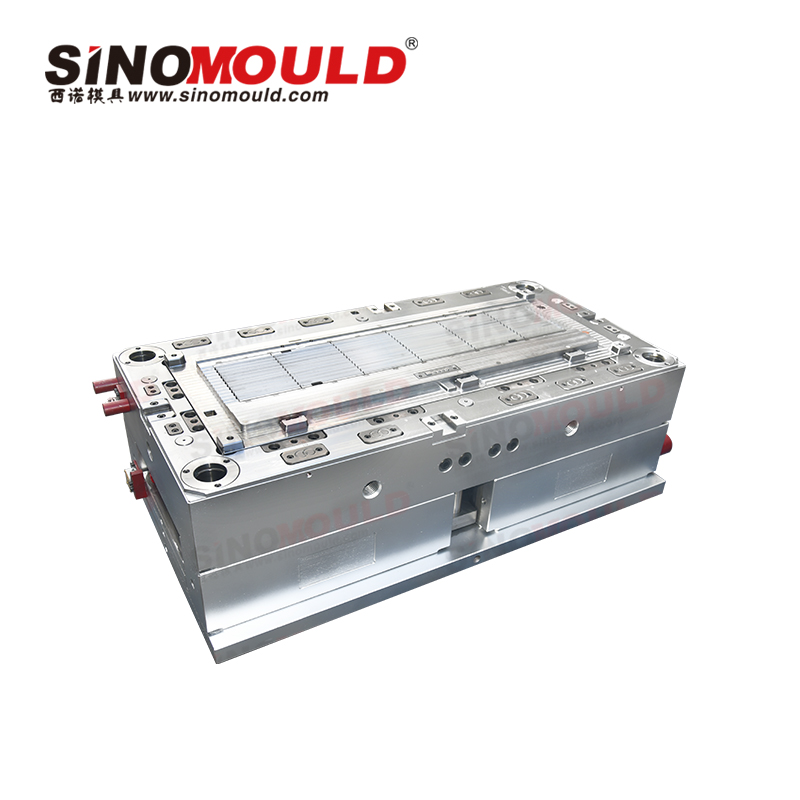
- Specification requirements: According to the part weight and size, select a large injection molding machine with a clamping force of 500-2000T and an injection volume of 1000-5000g. Priority is given to servo energy-saving equipment with low energy consumption and high control precision.
- Core requirements: The equipment must have high-precision injection control, segmented holding pressure and uniform clamping functions to avoid mold deformation caused by uneven clamping force; equipped with automatic feeding, automatic demolding and automatic detection systems to improve production efficiency.
- Cavity design: Adopt single-cavity or double-cavity design (according to production needs), and the cavity surface is polished (Ra≤0.8μm) to ensure smooth part appearance; the parting surface is reasonably designed to avoid obvious weld marks.
- Gating system: Adopt large gate or hot runner gating system. The hot runner system can reduce sprue waste, improve production efficiency and ensure uniform melt filling; the gate position is selected on the non-appearance surface or thick wall of the part to avoid affecting the appearance.
- Venting system: Set vent grooves (width 0.02-0.05mm, depth 0.1-0.2mm) at the end of melt flow, parting surface and other positions to timely discharge the air in the cavity and avoid defects such as bubbles and material shortage.
The core of molding large injection molded parts for home appliance casings (air conditioners, washing machines) is to solve the three major problems of “dimensional deviation, appearance defects and structural molding”. By reasonably selecting raw materials, optimizing process parameters, adapting equipment and molds, and strengthening the whole-process quality control, the efficient and stable production of large injection molded parts can be realized, ensuring that the product quality meets industry standards and market demands.